|
 The Tahuantinsuyo The Tahuantinsuyo
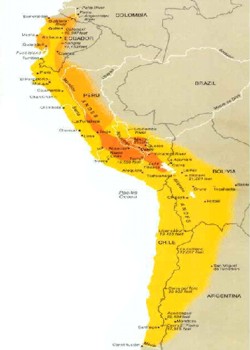
The greatest and oldest empire, developed in the American
continent and that had the city of Cusco as its headquarters,
goes back to the year 1200 A.C. The word Tawantinsuyo comes
from a name composed by two Quechua terms: Tawa, which means
four; and Suyo, which means StateThe Incas' Andean dominance
was achieved through formidable organization and a highly
developed economic system. The Incas rapidly expanded their
empire first through political alliances and absorption, and
then by swift military conquest. Though the Incas imposed
their social structure and way of life, they also
assimilated useful skills and practices, even granting
administrative positions to defeated nobles of the Chimú and
other cultures. The Incas thus succeeded in achieving
political and religious unification across most of their
domain.
The Incas recorded an astounding
level of achievement. They never developed a system of
writing, but they kept extraordinary records with an
accounting system of knots on strings, called quipus. They
laid a vast network of roadways, nearly 32,200km (20,000
miles) total across the difficult territory of the Andes,
connecting cities, farming communities, and religious sites.
A network of runners, called chasquis, operated on the roads,
relaying messages and even transporting foodstuffs from the
coast to the Andes. Tambos, or way stations, dotted the
highways, serving as inspection points and shelters for
relay runners. The Inca Trail was a sacred highway,
connecting the settlements in the Urubamba Valley to the
ceremonial center, Machu Picchu.
 The Incas' agricultural techniques The Incas' agricultural techniques
were exceedingly skilled and efficient, with advanced
irrigation systems and soil conservation. The Incas were
also extraordinary architects and unparalleled stonemasons.
Inca ruins reveal splendid landscaping and graceful
construction of perfectly cut stones and terraces on
inaccessible sites with extraordinary views of valleys and
mountains.
A rigid hierarchy and division of labor ruled Inca society.
At the top, just below the Inca sovereign (who was also the
chief military and religious figure and considered a
descendant of the sun), was the ruling elite: nobles and
priests. Tens of thousands of manual laborers provided the
massive manpower necessary to construct temples and palaces
throughout the empire. The Inca kept chosen maidens, or
Virgins of the Sun (acllas), who serviced him and Inca
nobles.
Extraordinarily tight community organization
was replicated across the empire. At the heart of the
structure was the Inca's clan, the panaca, composed of
relatives and descendants. Spanish conquistadors chronicled
a dynasty that extended to 12 rulers, from Manco Cápac, the
empire's founder in 1200 who was said to have risen out of
Lake Titicaca, to Atahualpa, whose murder in Cajamarca by
Spanish conquerors spelled the end of the great power.
The Inca Pachacútec
ruled from 1438 to 1463, and he is considered the great
builder of Inca civilization. Under his rule, Cusco was
rebuilt, and some of the most brilliant examples of Inca
architecture were erected, including Cusco's Qoricancha
(Temple of the Sun), the Ollantaytambo and Sacsayhuamán
fortresses, and, of course, the famed religious city of
Machu Picchu. Pachacútec also initiated the empire's
expansion. It was Pachacútec's successor, Tupac Yupanqui
(1463-93), however, who achieved dominance from Ecuador to
Chile. A great conqueror, he defeated his Chimú rivals in
northern Peru.
After the death of the Inca Huayna Cápac in 1525, civil war
ensued, brought on by the empire splitting between his two
sons, Atahualpa and Huáscar. The Spaniards, arriving in
northern Peru in 1532, found a severely weakened empire -- a
pivotal reason the Incas so swiftly succumbed to a small
band of invading Spaniards. Another key was the Spaniards'
superior military technology. Against cannons and cavalry,
the Incas' slings, battle-axes, and cotton-padded armor
stood little chance. But their defeat remains puzzling to
most visitors to Peru, not to mention many scholars. |